This Underrated System Powers Your Well-Being - Lymphatics
As he lies down on the floor in Savasana, Jack notices a certain quality of spaciousness and silence he never experienced before. It’s a capacity that seems to be always available and present, yet so elusive and hidden to the naked eye. He is not an organism separate from all space; he is space; there is space.
Many of us go through our days (and lives) oblivious to the underlying systems that give and take life, often detached from them, seeing them as something out there and disconnected from ourselves, which we can’t consciously sense. But this is not true. We can sense many of them if we choose so and practice.
One of the core systems of our body is the lymphatic system, a deep web of vessels running throughout the body and cleaning up “waste”, contributing to overall well-being (vitality, reduction of sickness), proper digestion, beauty, including the appearance of clear skin, no swelling, youthfulness*.
*all qualities that evolutionarily signal health and fertility, a great mix for reproductive attraction, which is very much sought after at magnified scale in many personal accounts on social media for understandable (to some degree) evolutionary reasons.
Since the lymphatic system doesn’t have an inherent “pump” that drives its activation and movement (like the cardiovascular system does, where the heart is the “pump”), its activation and circulation rely on movement—both “internal” (e.g., breathing), and “external”.
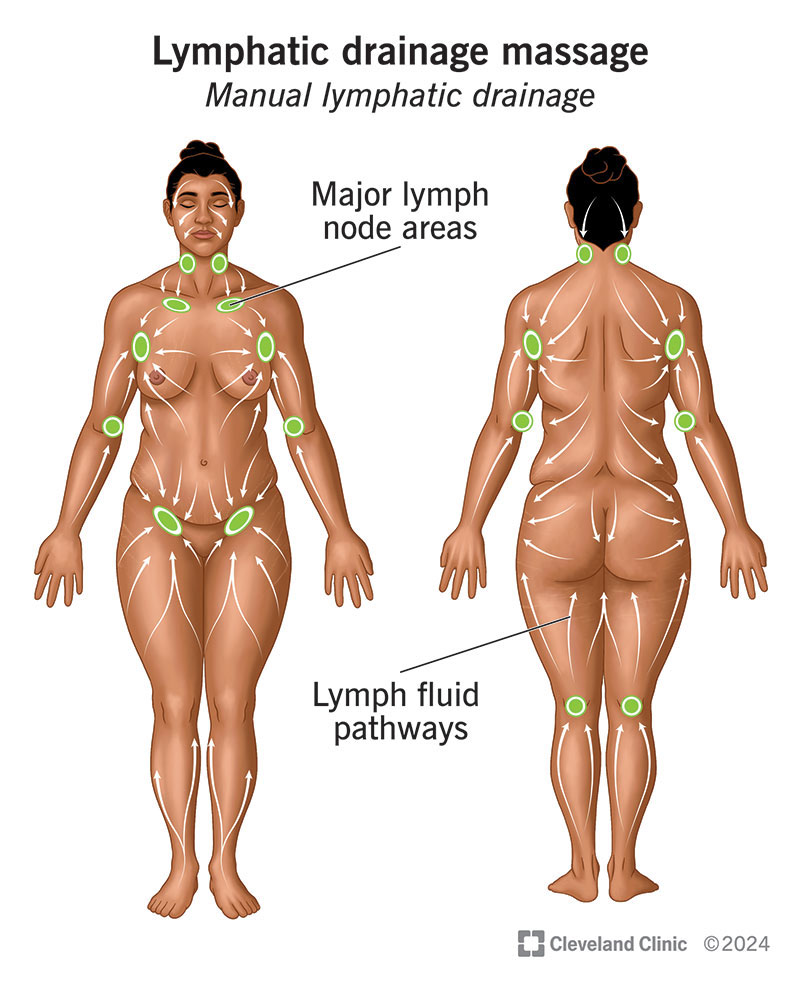
Source: Cleveland Clinic
How It Works
There are specific areas of the body where lymph nodes are located to facilitate and direct the flow of fluids toward the heart space (around the clavicles), where lymph drains back into the bloodstream. Lymph nodes sometimes swell when there is sickness (e.g., in the throat, armpits, inner thigh, and many other areas) because they are the spots where the immune system “checks” for possible external threats acting on the body and producing illness (bacteria, viruses, fungi). We can conceptualize lymph nodes as “security checkpoints”.
As lymph moves through the lymphatic vessels, it gets checked-up by the “local lymph police” at each lymph node, to ensure there are no prohibited substances smuggled in. If there are such substances, the battle to remove them begins. For example, a swollen knee after an injury is a sign of inflammation in the area, with lymph fluid accumulating as part of that inflammatory response. Movement is key in removing swelling and inflammation, despite common advice being to refrain from movement when there is an injury.
Lymph fluid is essentially filtered blood plasma — the clear, watery part of blood — that has seeped out of your capillaries into the spaces between your cells (the interstitial space). Once outside the bloodstream, this fluid picks up cellular waste (ammonia, CO₂, debris from normal cell activity), proteins that are too large to re-enter blood capillaries directly, immune cells (white blood cells), fats absorbed from the gut (via specialized lymphatic vessels called lacteals).
At that point, it's called lymph. It's slightly viscous — not as fluid as water, not a gel either — because of all the stuff it's carrying.
The lymphatic system is the plumbing that collects and moves this fluid:
Lymphatic capillaries (tiny, one-cell-thick vessels in your tissues) absorb the excess interstitial fluid
It flows through progressively larger lymphatic vessels — all one-way, using valves to prevent backflow
Along the way, it passes through lymph nodes, where immune cells inspect it for bacteria, viruses, or other threats
Eventually, the cleaned-up lymph drains back into your bloodstream at the subclavian veins near the clavicles
The Role of Movement
Regular exercise (zone 2 cardio, resistance training, etc.) does naturally activate the lymphatic system by boosting muscle contractions, joint motion, breathing and cardiovascular output (De Oliveira et al., 2018). Muscle contractions squeeze lymph vessels, breathing creates pressure differentials in the thoracic cavity that pull lymph upward, joint motion opens and closes valves.
Human and animal data show exercise alone can raise lymph clearance 3-6× compared with rest, and increase lymphatic contraction frequency and flow (De Oliveira et al., 2018). The most effective investment in your lymphatic system health is to keep moving. Exercise is the foundation, but you can go deeper in the practice.
To experiment further and directly target the lymphatic system, you can perform specific practices listed below. These practices let you target lymph flow directly and deliberately, the way a stretching practice targets flexibility beyond what running alone provides.
Activation Practices
Conscious lymphatic system activation means intentionally using movement or touch to stimulate lymph flow, rather than just relying on automatic function. You’re targeting lymph flow the way you’d target a specific muscle group in a resistance training session.
Conscious lymphatic system activation requires specific movements that aid the natural flow of lymphatic fluid, which flows one-way (up towards the clavicles). Here is an overview of some practices targeting the lymphatic system.
The Vertical Shake (Ido Portal): continuous gentle bouncing paired with scanning the body and releasing tensions. The rhythmic vertical compression pumps lymph through vessels with full-body coverage.
Manual lymphatic drainage (MLD): a specific, gentle massage designed to enhance lymph vessel filling and emptying and improve lymph drainage (Nahar et al., 2024; Thompson et al., 2020; Palmer, 2024; Choi et al., 2019). The logic is: open central, less‑congested territories first, then bring peripheral fluid toward them (“proximal‑to‑distal, then distal‑to‑proximal”). Read this short guide and watch this video to learn more about how to do MLD.
MLD works by mechanically stimulating lymph capillaries and collectors with precise, gentle, skin‑stretching movements that open more lymphatic pathways, boost lymph pumping, and redirect fluid from congested areas to functioning territories
NOTE
When you're sick, the checkpoints are actively processing threats. Stimulating flow bypasses or overwhelms that checkpoint process. It's a situation where it is best NOT TO perform manual lymphatic drainage and other lymphatic activation practices, because doing so would foster the spread of the infection.
Lymphatic pump techniques: hands‑on rhythmic pumping (e.g., thoracic or pedal pump) that augments the body’s inherent lymphatic pumping and immune responses (Franzini et al., 2018; Scallan et al., 2016). Watch this video for an example.
Diaphragmatic breathing: the inhale travels through the entire respiratory system, driven by the diaphragm, which sits at the base of the ribcage, separating the thoracic cavity (lungs, heart) from the abdominal cavity. The diaphragm contracts and flattens downward on the inhale (creating negative pressure that pulls air in), and relaxes and domes upward on the exhale. Each breath cycle acts as one pump stroke. Deep, slow diaphragmatic breathing maximizes the excursion (how far the diaphragm moves), which maximizes the pressure differential, which maximizes the “pumping” effect. Shallow chest breathing barely moves the diaphragm and produces a much weaker “pump”.
These practices target lymph flow while you're awake. But the lymphatic system does some of its most critical work while you sleep — particularly in the brain.
The Role of Sleep
The lymphatic system pathway that operates in the brain is called glymphatics. This system clears brain waste during sleep, provided you get enough quality sleep. When sleep is not sufficient, you may notice a sensation of fogginess. That’s a sign of insufficient waste clearance during the night.
During sleep, especially non‑REM deep sleep, the cerebrospinal fluid (CSF)* flow through the glymphatic system increases, enhancing clearance of metabolic waste—proteins like amyloid-β and tau that, when they build up, are linked to neurodegenerative diseases like Alzheimer's—from brain tissue (Reddy & Van Der Werf, 2020; Hauglund & Pavan, 2020; Rasmussen et al., 2018; Lundgaard et al., 2017).
When you're awake, your brain cells are swollen with activity. When you fall into deep sleep, noradrenaline** levels drop, your brain cells shrink slightly, and the gaps between them widen, creating more room for cerebrospinal fluid to flush through and carry waste away (Reddy & Van Der Werf, 2020; Voumvourakis et al., 2023; Li et al., 2022).
*Cerebrospinal fluid (CSF) is the clear liquid that surrounds and cushions the brain and spinal cord, akin to a shock absorber. During deep sleep, CSF flows through the brain more actively to wash away metabolic waste (like proteins that build up during waking hours), which is why long-term good sleep is so important for brain health.
**Noradrenaline (also called norepinephrine) is a chemical messenger in the brain that keeps you alert and focused when you're awake.
Poor glymphatic clearance is associated with increased risk of neurodegenerative disease. This makes sleep as essential as movement for maintaining a healthy lymphatic system.
Conclusion
For someone who already “moves” (i.e., practices some sports/exercise), conscious lymphatic system activation practices are an additional tool in the kit. Combined with quality sleep, which clears brain waste through the glymphatic system, these three pillars form a complete picture of lymphatic health. For someone who moves very little or has chronic illness, lymphatic system activation is a great accessible entry point to greater well-being. It is low-impact and doesn’t take much time.
Movement alone stimulates lymphatic system activation significantly, and it can be enough for healthy people. There is more to conscious lymphatics practices than the research captures. They can be a portal to a greater connection with the entire body, which is missing in many of us. Yet, there is a body, and it can be a major portal to the peace, spaciousness, and silence that’s always present, if you are willing to notice it. That quality of spaciousness Jack noticed on the floor? It is always there.
Resources
De Oliveira, M., Gurgel, M., Amorim, B., Ramos, C., Derchain, S., Furlan-Santos, N., Santos, C., & Sarian, L. (2018). Long term effects of manual lymphatic drainage and active exercises on physical morbidities, lymphoscintigraphy parameters and lymphedema formation in patients operated due to breast cancer: A clinical trial. PLoS ONE, 13. https://doi.org/10.1371/journal.pone.0189176
Thompson, B., Gaitatzis, K., De Jonge, X., Blackwell, R., & Koelmeyer, L. (2020). Manual lymphatic drainage treatment for lymphedema: a systematic review of the literature. Journal of Cancer Survivorship, 15, 244 - 258. https://doi.org/10.1007/s11764-020-00928-1
Nahar, H., Al-Dossari, B., Shamsi, S., & Keridis, O. (2024). Manual Lymphatic Drainage and Exercises in Management of Secondary Lymphedema Following Mastectomy-Systemic Review. International Journal of Recent Innovations in Medicine and Clinical Research. https://doi.org/10.18231/j.ijrimcr.2024.028
Palmer, S. (2024). An overview of manual lymphatic drainage.. British journal of community nursing, 29 9, 438-440. https://doi.org/10.12968/bjcn.2024.0101
Franzini, D., Cuny, L., & Pierce-Talsma, S. (2018). Osteopathic Lymphatic Pump Techniques. Journal of Osteopathic Medicine Journal of Osteopathic Medicine, 118, e43 - e44. https://doi.org/10.7556/jaoa.2018.112
Choi, D., Park, E., Jung, E., Cha, B., Lee, S., Yu, J., Kim, P., Lee, S., Hong, Y., Koh, C., Cho, C., Wu, Y., Jeon, N., Wong, A., Shin, L., Kumar, R., Bermejo-Moreno, I., Srinivasan, R., Cho, I., & Hong, Y. (2019). Piezo1 incorporates mechanical force signals into the genetic program that governs lymphatic valve development and maintenance.. JCI insight, 4 5. https://doi.org/10.1172/jci.insight.125068
Scallan, J., Zawieja, S., Castorena-Gonzalez, J., & Davis, M. (2016). Lymphatic pumping: mechanics, mechanisms and malfunction. The Journal of Physiology, 594. https://doi.org/10.1113/jp272088
Reddy, O., & Van Der Werf, Y. (2020). The Sleeping Brain: Harnessing the Power of the Glymphatic System through Lifestyle Choices. Brain Sciences, 10. https://doi.org/10.3390/brainsci10110868
Hauglund, N., & Pavan, C. (2020). Cleaning the sleeping brain – the potential restorative function of the glymphatic system. Current Opinion in Physiology, 15, 1-6. https://doi.org/10.1016/j.cophys.2019.10.020
Rasmussen, M., Mestre, H., & Nedergaard, M. (2018). The glymphatic pathway in neurological disorders. The Lancet Neurology, 17, 1016-1024. https://doi.org/10.1016/s1474-4422(18)30318-1
Voumvourakis, K., Sideri, E., Papadimitropoulos, G., Tsantzali, I., Hewlett, P., Kitsos, D., Stefanou, M., Bonakis, A., Giannopoulos, S., Tsivgoulis, G., & Paraskevas, G. (2023). The Dynamic Relationship between the Glymphatic System, Aging, Memory, and Sleep. Biomedicines, 11. https://doi.org/10.3390/biomedicines11082092
Li, W., Chen, D., Liu, N., Luan, Y., Zhu, S., & Wang, H. (2022). Modulation of lymphatic transport in the central nervous system. Theranostics, 12, 1117 - 1131. https://doi.org/10.7150/thno.66026
Lundgaard, I., Lu, M., Yang, E., Peng, W., Mestre, H., Hitomi, E., Deane, R., & Nedergaard, M. (2017). Glymphatic clearance controls state-dependent changes in brain lactate concentration. Journal of Cerebral Blood Flow & Metabolism, 37, 2112 - 2124. https://doi.org/10.1177/0271678x16661202