
Day 30 | Daily Dose of learning
This project is inspired by the ‘100-day project’, a challenge consisting of committing to doing an activity everyday for 100 days.
I have decided to write about one thing I learn everyday for the next 30 days. This can be a skill, a deep concept to elaborate on, or a mere life lesson that made me become aware of something I consider relevant.
The decision is based on the belief that “we are what we repeatedly do”, as Valentin Perez put it.
Discipline, and the Importance of Showing Up.
A widespread belief in the productivity world is that when you want to learn something, become better at some skill, or successfully conclude a project, making that activity a habit will increase the chance for you to actually complete that objective or vision.
James Clear, author of ‘Atomic Habits’, has a vast library of articles on the topic of habit setting and he shares valuable tips and tricks to succeed in the habit building process.
It all boils down, however, to intrinsic motivation, trying to tie down habits to your identity, and being inspired to stick to the habits you want to build for yourself.
Discipline also plays a role. Discipline gives structure. It provides clarity of intentions and personal responsibility to follow through the activities. Discipline is the internal drive to do what you need or want to get done because it is something that adds value to your life.
Finally, showing up, no matter what, is another pillar of building a habit or finishing a project you have to conclude. There are days in which you just do not feel like grabbing the pen and writing, or practice playing the guitar. It is in those days that it is the most important to show up. Showing up means just starting. It means making a compromise with yourself, and beginning the task at hand without great expectations. If that lack of willpower continues, then it will mean that you’ll stop after 5 minutes from starting. Other times, however, you will find willpower come along, once the activity has begun. In both cases, that’s a win.
Day 29 | Daily Dose of learning
This project is inspired by the ‘100-day project’, a challenge consisting of committing to doing an activity everyday for 100 days.
I have decided to write about one thing I learn everyday for the next 30 days. This can be a skill, a deep concept to elaborate on, or a mere life lesson that made me become aware of something I consider relevant.
The decision is based on the belief that “we are what we repeatedly do”, as Valentin Perez put it.
The 5-Hour Rule
There seems to be a common habit some successful people like to practice. It is the dedication to learning. The innate drive to spend time enriching their baggage of knowledge and reflect.
Most of us perceive, however, that time in our lives is increasingly limited, and tend to think it is especially so for people with high degrees of responsibility, whose level of ‘busyness’ is unimaginable.
Well, apparently, that’s not exactly the case, in particular for some ‘successful’ people like investor Warren Buffet, former USA president Barack Obama, and Benjamin Franklin.
It is exactly Benjamin Franklin, supposedly, who invented the ‘5-Hour Rule’: DEDICATE ONE HOUR A DAY TO LEARNING, 5 DAYS PER WEEK. Some refer to this rule also as ‘compound time’.
The 5-hour rule is more than just a habit to try to fit in our lives. It is a way of living that is based on the belief that we are what we do and that continuously evolving our skillset and knowledge base does not simply serve as a means to achieve an objective, but as a way to get closer to the best version of ourselves.
“whatever you do, just keep learning.”
Day 28 | Daily Dose of learning
This project is inspired by the ‘100-day project’, a challenge consisting of committing to doing an activity everyday for 100 days.
I have decided to write about one thing I learn everyday for the next 30 days. This can be a skill, a deep concept to elaborate on, or a mere life lesson that made me become aware of something I consider relevant.
The decision is based on the belief that “we are what we repeatedly do”, as Valentin Perez put it.
Grit
This is from a video by Ali Abdaal on the book ‘Grit’ by Angela Duckworth.
Generally, we tend to think that talent is what makes the difference when it comes to being successful. What if this is not exactly true? What if there’s something more to it?
“Our vanity, our self-love, promotes the cult of the genius. For if we think of genius as something magical, we are not obliged to compare ourselves and find ourselves lacking.”
In the book ‘Grit’, author Angela Duckworth (psychologist at the University of Pennsylvania) explores the roots of success by diving into the discoveries she made during years of research in the field. And she digs deep into explaining why grit matters and what makes the real difference in achieving ‘success’.
Duckworth argues that passion and effort are key components to achievement and success.
ACHIEVEMENT= TALENT x EFFORT^2
PASSION + PERSEVERANCE = GRIT
The first key component to grit is therefore ‘passion’, which is to be found by exploring things, making experiences, trying many activities and expanding one’s comfort zone in order to find something that is genuinely interesting.
Second, ‘perseverance’. There are 2 main concepts to perseverance. The first one is the mindset of deliberate practice (i.e. working smartly and intentionally on the thing you want to improve / learn with a long-term mindset). The second is ‘kaizen’, the japanese way of living that is centered around continuous improvement.
Third component of ‘grit’ is purpose, which is part of the passion element of the equation. Purpose refers to the intrinsic ‘why’ of doing something; the reason that guides the actions.
Fourth and last, develop a growth mindset, i.e. a mindset oriented towards becoming better, everyday, and believing that improvement is possible and depends on your daily choices. A growth mindset is the opposite of a fixed mindset.
Day 27 | Daily Dose of learning
This project is inspired by the ‘100-day project’, a challenge consisting of committing to doing an activity everyday for 100 days.
I have decided to write about one thing I learn everyday for the next 30 days. This can be a skill, a deep concept to elaborate on, or a mere life lesson that made me become aware of something I consider relevant.
The decision is based on the belief that “we are what we repeatedly do”, as Valentin Perez put it.
The Blockbuster Mental Model
From the article ‘Blockbuster: the #1 Mental Model for writers who want to create high-quality, viral content’ by Michael Simmons.
Often, productivity experts recommend to churn out as much content as possible for a long period of time in order to reap the benefits at some point.
In this article, Michael Simmons presents a different approach to writing: the Blockbuster mental model.
This approach to writing is all about focusing on producing very high quality content, with intention, a lot of research and time spent studying the topic you are writing about.
The main reason for this being rooted in the graph which depicts the popularity of content on the internet against the amount of content produced.
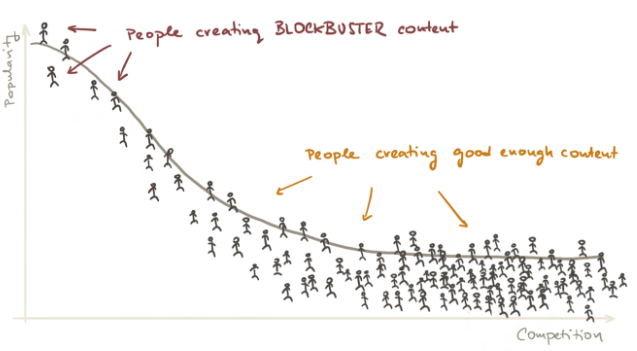
In order to be at the top of the distribution, according to the author, the content you put out has to significantly stand out from the crowd. And to create such content one needs to double down on quality rather than quantity. This translates into many hours of research and well-thought-after final pieces. At the expense of quantity. As a matter of fact, dedicating 50+ hours on each article / piece of content allows to publish only a limited number of final products a month. Final products which are, however, deeply valuable and resonating with the audience, which plays a huge role in the spread of the content.
Day 26 | Daily Dose of learning
This project is inspired by the ‘100-day project’, a challenge consisting of committing to doing an activity everyday for 100 days.
I have decided to write about one thing I learn everyday for the next 30 days. This can be a skill, a deep concept to elaborate on, or a mere life lesson that made me become aware of something I consider relevant.
The decision is based on the belief that “we are what we repeatedly do”, as Valentin Perez put it.
6 steps to a successful writing habit
From the course ‘The Writer's Toolkit: 6 Steps to a Successful Writing Habit’ by Simon Van Booy on Skillshare.
Writing is not merely a gift of few. It is, rather, a skill that can be learnt by many through practice, habits, environment design.
In his Skillshare course, Simon Van Booy shares 6 steps to establishing good writing routines and take on the habit of writing, which, he underlines, can be done by all of us, with each one having his / her own style. Style which you’ll find only by practicing writing. Here are the steps Simon illustrates, together with some notes and a final note from the author.
The 6 steps
Make your own space
Find your medium
Read inspiring works
Set the conditions
Stick to a routine
Sketching to stay inspired
1- Make Your Own Space
This is part of environment design. Having a specific space that you associate with writing is crucial in order to set the habit of writing. It must be a space where you feel safe; where you are with your own thoughts and feel you can express the best.
There will never be a perfect space. Be ok with imperfection; the key thing is to feel at your best in the space you are.
2 - Find Your Medium
Exist in solitude during writing time. The medium can be whatever you want: tablet, laptop, pen and paper. The key is to not feel overwhelmed by it. Choose a medium that does not make you feel absolutely burdened by writing a lot.
Get rid of distractions. Turn off internet connection. Take the time for yourself and enjoy the process. this reminds me of the writing process of Derek Sivers, which he talks about here Deep Dive with Derek Sivers - Life Advice, Writing and Entrepreneurship - YouTube.
3 - Read Inspiring Works
What you're writing is a reflection of what you are reading. Reading works that you like provides you with ideas, inspiration, content learnt. There's nothing wrong with copying or repeating ideas already illustrated by the writers you love.
You will likely write about what you are reading and like reading.
4 - Set the Conditions
Again, environment design. Be aware of how you like the environment around you to be and what makes you feel 'in the zone' of writing. Commit to recreating that type of environment every time you write, as best as possible.
5 - Stick to a Routine
A routine makes it real. Having a writing routine where you are by yourself, with no distractions, and in the environment you want to be, makes writing a serious thing, which is important, especially because routines hold you accountable and if you take it seriously the people around you will help you succeed.
6 - Sketching to Stay Inspired
Sketching refers to the habit of writing (in this case) in order to practice, keep sources of inspiration coming and become better. Sketching can be done from any object. Simon points at how he takes pictures of places he finds interesting and knows will use later on. And he writes about them, as well as other objects, on a sketch book. Sketching does not need to be fancy.
Please, Please read this... (by Simon Van Booy)
What's very important to realize, especially at this time--is that the only thing you need to write great fiction is the person staring back at you in the mirror. Look at that person, believe in that person; every journey starts with a leap of faith into the unknown. Even I feel anxious about writing, even after 13 books--but the urge to do it has to be stronger than the fear of failure. In my opinion, when your fingers hit the keys, or the pen touches paper--you've won in a very deep way.
We spend an enormous amount of time telling ourselves why it's not going to work. Coming up with reasons why it's too hard, or that we're not ready.
But once you see writing as something you MUST do, like getting up and going to work, or using the restroom when you're in the middle of something. Once you make this mental leap to a MUST instead of a WANT, and decide that writing a story is something that you absolutely have to do, then get excited because it's going to happen. There is nothing else in your way.
Maybe jot down a sentence right now, or perhaps the name of the street where the story takes place. These easy first steps will help you make the first stroke upon the canvas. And remember--there are no such things as mistakes. Every step will take you to the next.
The first draft might not be a good story. My first drafts are all terrible, shameful, horrible things. But it's a start and that's what counts. You can't get something from nothing. But from a first draft--even a page, even a paragraph, you can build and build until you have a piece of writing that's superb and that you can read aloud and be pleased with, or perhaps something you can use to start building a longer piece--such as a novel.
Remember, writing is not easy. The most exciting part sometimes comes after the most boring part--laying down a first draft.
It is rather like building a house.
If you are like many people, then it's the decorating that's really the fun part. But for most of the construction, it's a messy, ugly process, and everything feels like it's going wrong. If this is how writing feels to you, then that's a really good sign, because it means you're trying to wrestle out something completely amazing. You're trying to create something new and original in the world. Bravo!
At this point you have a decision to make. You can be someone who gives up, or someone who keeps going. Relentless people are those who come up with cures for elusive diseases, invent brilliant machines, and make huge contributions to society through the medium which feels most natural to them. If you don't believe me, ask anyone who is massively successful, and they'll list (probably with great enjoyment) the many times they have failed in their attempts to do something great.
The sooner you get used to feeling like you've failed, the sooner you can channel that energy back into your work.
As for the image of me in Paris with a camera, this was a time in in my life when I couldn't sell a story, or a book, or anything. I might look confident, but I was freaking out. On that trip I doubted everything I thought I knew. But I kept writing because I had stories to tell. Your 'will' can be stronger than fear, so trust yourself. It reminds me of the musicians who played while the Titanic was sinking. They did what they loved right up to the end.
If you want to write a story. Just start. Get a few words down, a paragraph, a page, anything. Then just keep going back to it. Be relentless. Remember also to read books only that inspire you. Don't think about becoming a writer, write yourself into one.
Then just write and write, and don't let fear hold you back. Write the sort of story that you would LOVE to read. There is nothing in your way now except the obstacles you have imagined, but which don't exist outside your mind.
Let this weird time be the season you take control of your work, and break the old habits that are holding you back.
You friend, as always, through good times and bad,
Simon
Day 25 | Daily Dose of learning
This project is inspired by the ‘100-day project’, a challenge consisting of committing to doing an activity everyday for 100 days.
I have decided to write about one thing I learn everyday for the next 30 days. This can be a skill, a deep concept to elaborate on, or a mere life lesson that made me become aware of something I consider relevant.
The decision is based on the belief that “we are what we repeatedly do”, as Valentin Perez put it.
Don’t kill time, use it intentionally
This brief post is about killing time, leisure time, and how we have been shifting our habits on sedentary, passive leisure time activities. It draws from an article by David Perell entitled ‘Don’t Kill Time’.
Leisure time is sometimes demonized by the ‘productivity, always, no matter what’ current of thought, which sustains that doing an activity that does not make money is a waste of time, and time is scarce.
Time is certainly scarce, and death pressing on all of us. David Perell, however, makes a great point about using free time intentionally, by doing activities that are purposeful and meaningful to us. Those activities that elicit the state of flow in us, which do not necessarily have to be what society considers ‘fun’, ‘entertaining’, or ‘relaxing’.
As Perell explains, leisure time is not killing time. Time is valuable and spending it on passive, slothful activities is likely not the best way to use it. The reason being that we often associate free time with ‘time free from the burden of work’, hence time to ‘retreat from the world’. Whereas a more intentional and aware mindset to have would be to consider both work and leisure as ‘gifts to embrace’.
“Instead of seeing how leisure can create wisdom, we think like an economy thinks — as if only transactions can create value. Leisure is not a time to retreat from the world. Rather, it’s a time for poetry, prayer, and philosophy — a chance to reflect on where we’ve been, where we are, and where we’re going. ”
Day 24 | Daily Dose of learning
This project is inspired by the ‘100-day project’, a challenge consisting of committing to doing an activity everyday for 100 days.
I have decided to write about one thing I learn everyday for the next 30 days. This can be a skill, a deep concept to elaborate on, or a mere life lesson that made me become aware of something I consider relevant.
The decision is based on the belief that “we are what we repeatedly do”, as Valentin Perez put it.
Learning the basics - drawing | 2
Today’s drawing basics lesson has been focused on drawing lines, always keeping in mind that the foundation of every drawing is done through light lines, in order to depict a first draft of the final piece.
Lines are one of the most basic shape, and one of those shapes that can be seen the most in sketches.
Today’s practice was to become more confident at drawing lines and shapes made of lines for several times and with different angles (as for oblique lines).

Day 23 | Daily Dose of learning
This project is inspired by the ‘100-day project’, a challenge consisting of committing to doing an activity everyday for 100 days.
I have decided to write about one thing I learn everyday for the next 30 days. This can be a skill, a deep concept to elaborate on, or a mere life lesson that made me become aware of something I consider relevant.
The decision is based on the belief that “we are what we repeatedly do”, as Valentin Perez put it.
The Big Five Dimensions of Personality
Understanding one’s own personality traits can be a way of figuring out our characteristics, become aware of them, and act consequently when it comes to making life decisions. And trying to better understand our traits is also the first step of attempting to decide what to do in the future for young people.
The Big Five Personality traits is one of the most popular and accurate framework used by professionals to assess a person’s personality type.
It is based on 5 general aspects that identify people mostly based on their behaviour in different areas of life. The 5 traits are:
Agreeableness (Compassion and Politeness)
Conscientiousness (Industriousness and Orderliness)
Extraversion (Enthusiasm and Assertiveness)
Neuroticism (Withdrawal and Volatility)
Openness to Experience (Intellect and Openness)
Day 22 | Daily Dose of learning
This project is inspired by the ‘100-day project’, a challenge consisting of committing to doing an activity everyday for 100 days.
I have decided to write about one thing I learn everyday for the next 30 days. This can be a skill, a deep concept to elaborate on, or a mere life lesson that made me become aware of something I consider relevant.
The decision is based on the belief that “we are what we repeatedly do”, as Valentin Perez put it.
Learning the basics - drawing
Light lines are apparently the foundation of drawing. When we are given a pencil, we think about it in terms of a tool for writing or drawing, but we hold it in the way we were probably taught when we were children, without even thinking about it (at least this applies to me).

When it comes to drawing, however, the first step is to draw light lines, which can be barely seen on the paper. This helps with sketching a first draft and possible lines of the work. And to do this, the side of the pencil tip must be used, which requires a different way of holding the drawing tool. Brent Eviston, author of the Skillshare course on drawing, suggests an overhand grip, as it allows to use the side of the tip of the pencil, hence fostering the drawing of soft lines.

picture from the Skillshare course by Brent Eviston
So, the first exercise of the course was to practice drawing soft lines for 30 minutes.

Day 21 | Daily Dose of learning
This project is inspired by the ‘100-day project’, a challenge consisting of committing to doing an activity everyday for 100 days.
I have decided to write about one thing I learn everyday for the next 30 days. This can be a skill, a deep concept to elaborate on, or a mere life lesson that made me become aware of something I consider relevant.
The decision is based on the belief that “we are what we repeatedly do”, as Valentin Perez put it.
Deciding what to do in life
Unjaded Jade made a video on how to decide what to do in life some time ago. In that video, she shares a worth-considering technique of situational and introspective analysis. The ‘Odyssey plan’.
The Odyssey plan is based on 3 different questions we should ask ourselves when trying to make some mental clarity on what to do with our lives. The questions are meant to be answered rapidly, without overthinking, in order to avoid bias and manipulated answers as much as possible.
The first Odyssey Plan goes like this:
““ What will your life be like in 5 years if you continue to pursue your current path?” ”
Include where you would live; who you’d be surrounded with; what daily life would look like; responsibilities.
The second Odyssey Plan is based on the following question:
““What will your life be like in 5 years if you pursue a completely different path?””
The third and final question is:
““What would your life be like in 5 years if money and societal expectations didn’t exist?””
Answering these prompts is not the ultimate solution to deciding what to do. They may be very useful at bringing clarity and awareness as for the situation you are in. But they are meant to be integrated in a self-awareness plan which starts with being in tune with yourself and figuring out what are your personality traits as well as your aspirations.
In the end, as Jade suggests, we need to be ‘biased towards action’ and follow up on the vision we have, because over-analysing is likely unproductive.
Day 20 | Daily Dose of learning
This project is inspired by the ‘100-day project’, a challenge consisting of committing to doing an activity everyday for 100 days.
I have decided to write about one thing I learn everyday for the next 30 days. This can be a skill, a deep concept to elaborate on, or a mere life lesson that made me become aware of something I consider relevant.
The decision is based on the belief that “we are what we repeatedly do”, as Valentin Perez put it.
The Failed Simulation effect
In this article, Cal Newport introduces the idea of the failed simulation effect, what he presents as the psychological reason for which we are impressed by what some people are able to achieve in their lives. The failed simulation effect is what makes us think ‘how did he/she do that?’.
According to Newport, impressive achievements do not necessarily come from an innate intelligence or work-ethic of the person. In fact, they stem from doing the right things at the right time in a smart manner.
The key to creating that ‘wow’ effect, the author argues, is hidden behind the fact that people cannot figure out the path that led to the achievement. He makes the example of a student who ran a web design company while in high school, managing a dozen of clients. As this is very unusual, people cannot picture in their heads the path that made the student run a company while being a high school student. This intrigues the mind, hence eliciting the ‘wow’ reaction.
Actually, however, the time it took that student to run a business while studying was not that much compared to a student being the president of a student club.
Finally, Newport identifies 3 key steps that lead to impressive achievements:
Enter a Closed World and Exceed Expectations
Package Insider Connections
Escalate
Day 19 | Daily Dose of learning
This project is inspired by the ‘100-day project’, a challenge consisting of committing to doing an activity everyday for 100 days.
I have decided to write about one thing I learn everyday for the next 30 days. This can be a skill, a deep concept to elaborate on, or a mere life lesson that made me become aware of something I consider relevant.
The decision is based on the belief that “we are what we repeatedly do”, as Valentin Perez put it.
Just keep writing
Today I do not really know what to write about (or maybe I just do not want to think deeply enough). But I have recently come across a concept that applies to writing. It has to do with establishing the habit of writing instead of just writing whenever you ‘feel like’ doing it.
It is what distinguishes professionals from amateurs, according to James Clear and many productivity savvy.
It’s the idea that professionals do not wait for ‘inspiration’ or ‘motivation’ to write, or produce content in whatever field they are in. They just do it, on a schedule. And it does not matter how many words they write or how good the outcome is. They just write, whatever it is that comes to their mind about the topic at hand.
One way of applying this habit is to committing to writing a certain number of words (at a minimum) every day. This implies that there will be some days in which you really do not feel like writing, but you will write something anyways, regardless of how high-quality the work is. And there will also be some days when you are ‘inspired’ and have a lot to say. In those days you will likely write more than the minimum threshold required by the habit (which is usually a small number,e.g. 500/day, that allows you to ‘just start’ without feeling overwhelmed).
What’s more, this concept relies on the idea that motivation is a myth and that it comes along the way rather than beforehand. Which is another thing separating amateurs from professionals.
James Clear is an example of a person who used the habit of writing everyday regardless of inspiration or motivation and posting 2 articles a week for an extensive period.
Alright, this is about 300 words. I’m done here.
Day 18 | Daily Dose of learning
This project is inspired by the ‘100-day project’, a challenge consisting of committing to doing an activity everyday for 100 days.
I have decided to write about one thing I learn everyday for the next 30 days. This can be a skill, a deep concept to elaborate on, or a mere life lesson that made me become aware of something I consider relevant.
The decision is based on the belief that “we are what we repeatedly do”, as Valentin Perez put it.
Powerful Storytelling
In his course on storytelling, Keith Yamashita shares some very actionable tips on how to tell compelling stories that make listeners interested and involved along the narration.
He identifies and shares 6 main archetypes of a story:
‘Coming of Age’: after years of learning and experiencing, you have reached a milestone; you know who you are and are ready to take whatever comes next.
‘Overcoming Obstacles’: you went through many struggles, challenges, but managed to overcome everything and elevate to a better being.
‘Constant Evolution’: you take whatever comes on your way; you keep moving, adapting to the changing world and even anticipating events.
‘True as it ever was’: your purpose and values have remained intact throughout the years, despite the changing environment.
‘Rebirth’: you have accumulated a wealth of experience and knowledge. Today, you are using those to start a new chapter and become a better version of yourself.
‘Quest’: you have always had an objective and pursued it relentlessly. You have maintained your focus through twists and turns and will never let it up.
Day 17 | Daily Dose of learning
This project is inspired by the ‘100-day project’, a challenge consisting of committing to doing an activity everyday for 100 days.
I have decided to write about one thing I learn everyday for the next 30 days. This can be a skill, a deep concept to elaborate on, or a mere life lesson that made me become aware of something I consider relevant.
The decision is based on the belief that “we are what we repeatedly do”, as Valentin Perez put it.
The Impossible list
The impossible list is a more actionable and responsibility-holding bucket list. I encountered the impossible list on the course ‘How to build habits that last’ by Thomas Frank on Skillshare.
Write down a list of the things you want to accomplish in life. And then follow up. Not in a naive manner. Follow up focusing on a small number of goals at a time. As Thomas Frank suggests, also by recounting an anecdote from Warren Buffet, pick 3 goals from the list, and then get rid of all the others. This is useful to avoid distraction and procrastination-inducing activities.
Focus on building habits that will eventually lead to the achievement of the target as a byproduct.
Stick to the habits. Especially during the ‘dip’ phase: that period in which practicing the habit (e.g. playing the guitar) is hard, daunting and the initial spike in enthusiasm has faded away. By overcoming that phase and powering through it, you’ll be very close to making it. And be aware that the dip phase is when most people usually quit.
Finally, the Impossible list is not necessarily finite. It is a constantly-expanding list. Most of the times, achieving a goal does not mean that there is no next step. Every skill or life-event can be improved upon. So, as the basic principle behind the impossible list is to build habits and enjoy the process of achieving the goal rather than just setting a deadline and not a schedule, enriching the list with new steps to achieve is one of the differences between the impossible list and a generalist bucket list.
There are 3 types of progress, according to Thomas:
Gear acquisition, i.e. the initial stage of ‘motivation’ and purchase of the necessary stuff to learn a skill
Learning phase, the initial stage in which a lot of things make sense rapidly and progress is rather fast
Deliberate practice, which is where the ‘dip’ phase occurs. Practicing a lot is required when it comes to learning a skill, and overcoming the dip stage is empowering.
Day 16 | Daily Dose of learning
This project is inspired by the ‘100-day project’, a challenge consisting of committing to doing an activity everyday for 100 days.
I have decided to write about one thing I learn everyday for the next 30 days. This can be a skill, a deep concept to elaborate on, or a mere life lesson that made me become aware of something I consider relevant.
The decision is based on the belief that “we are what we repeatedly do”, as Valentin Perez put it.
How to do dumbbell rear-deltoid flies
The dumbbell rear-delt fly is a weighted exercise targeting the posterior side of the deltoid, the main muscle group in the shoulder region. It can be performed in different fashions: in a bent-over position while on your feet, seated, using a machine made for the exercise.
While training at the gym today, I was corrected while doing the exercise mentioned. Because the form I was using was wrong. So, the instructor came over to me and bluntly acknowledged the very ‘bad-looking’ execution of the movement I was implementing. And promptly corrected me. So, today I have learnt how to perform rear-delt flies in the right way, targeting the muscle the exercise is supposed to target.

Day 15 | Daily Dose of learning
This project is inspired by the ‘100-day project’, a challenge consisting of committing to doing an activity everyday for 100 days.
I have decided to write about one thing I learn everyday for the next 30 days. This can be a skill, a deep concept to elaborate on, or a mere life lesson that made me become aware of something I consider relevant.
The decision is based on the belief that “we are what we repeatedly do”, as Valentin Perez put it.
1 % better, consistently
The idea is rather straightforward and simple to understand. Yet, not that intuitive to put into practice. While reading an article by James Clear, today I’ve come across the infamous 1% rule, very preached in the productivity world and often explained through the British cycling team example of the perfect application of this concept.
The 1% rule states that by improving one percent consistently over the long run, results will increase exponentially for the better (‘results’ may just mean becoming a more knowledgeable individual or learning to play an instrument). James Clear writes about the 1% rule in his book ‘Atomic Habits’, whose excerpt about the anecdote of the British cycling team can be read here.
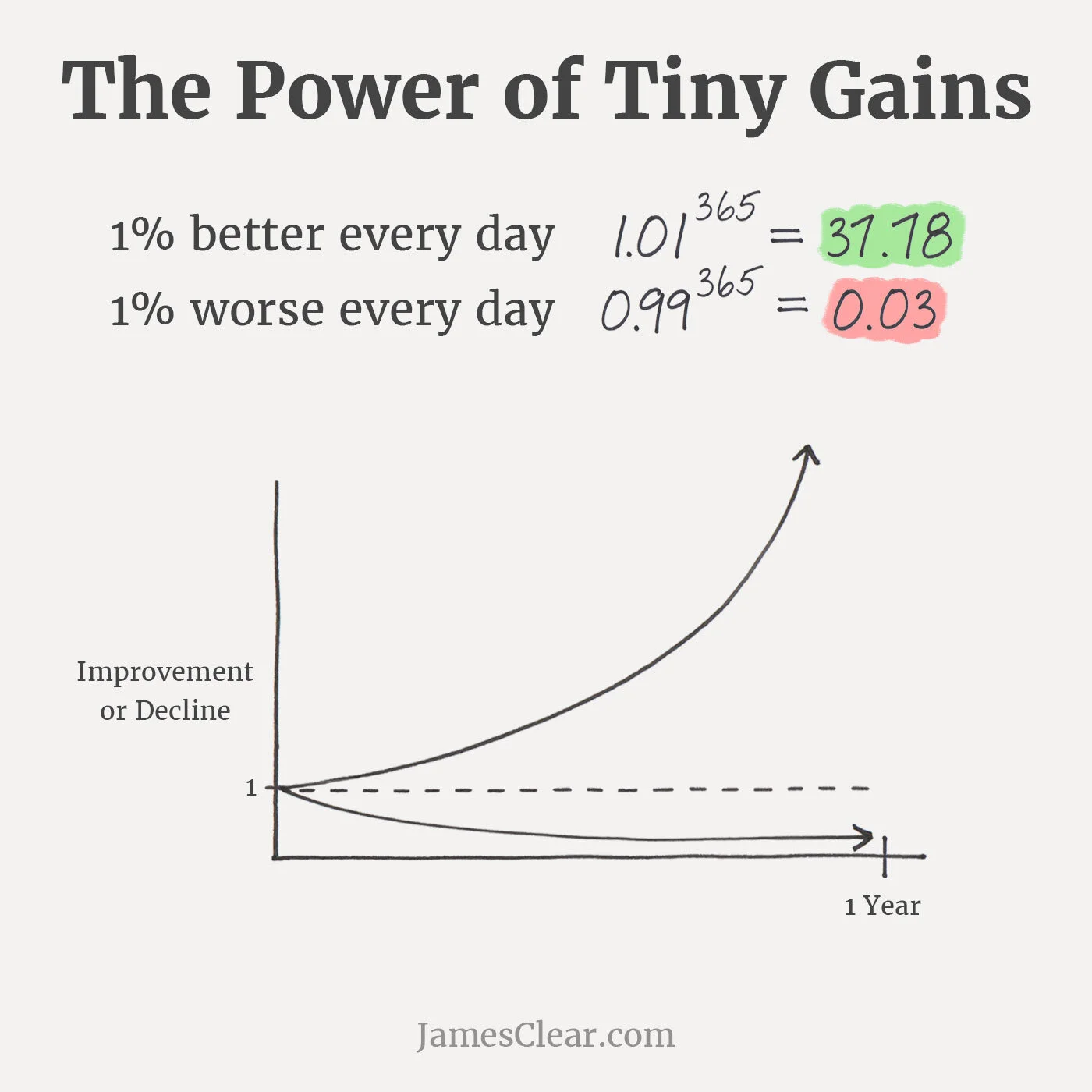
graph from the article by James Clear which shows the compound effect of small improvements. Click here for the source.
Day 14 | Daily Dose of learning
This project is inspired by the ‘100-day project’, a challenge consisting of committing to doing an activity everyday for 100 days.
I have decided to write about one thing I learn everyday for the next 30 days. This can be a skill, a deep concept to elaborate on, or a mere life lesson that made me become aware of something I consider relevant.
The decision is based on the belief that “we are what we repeatedly do”, as Valentin Perez put it.
The psychology of colors | Color Theory
Colors are not senseless. In fact, they have psychological and emotional meanings our minds associate them with. Even if unconsciously. Blue indicates trustworthiness and honesty? Brown is associated with reliability? This is what one of the lessons of the course on Color Theory on Skillshare focuses on.
While the psychological associations our mind makes with colours is a rather extensive topic, it is also insightful and intriguing when it comes to understanding why we like and are drawn to some colours more than others. As a matter of fact, this has probably a lot to do with our own personality and perception of the world.
Color Theory and the psychology of colours can be very helpful for figuring out why certain companies use specific colours and the message they want to convey to the world.
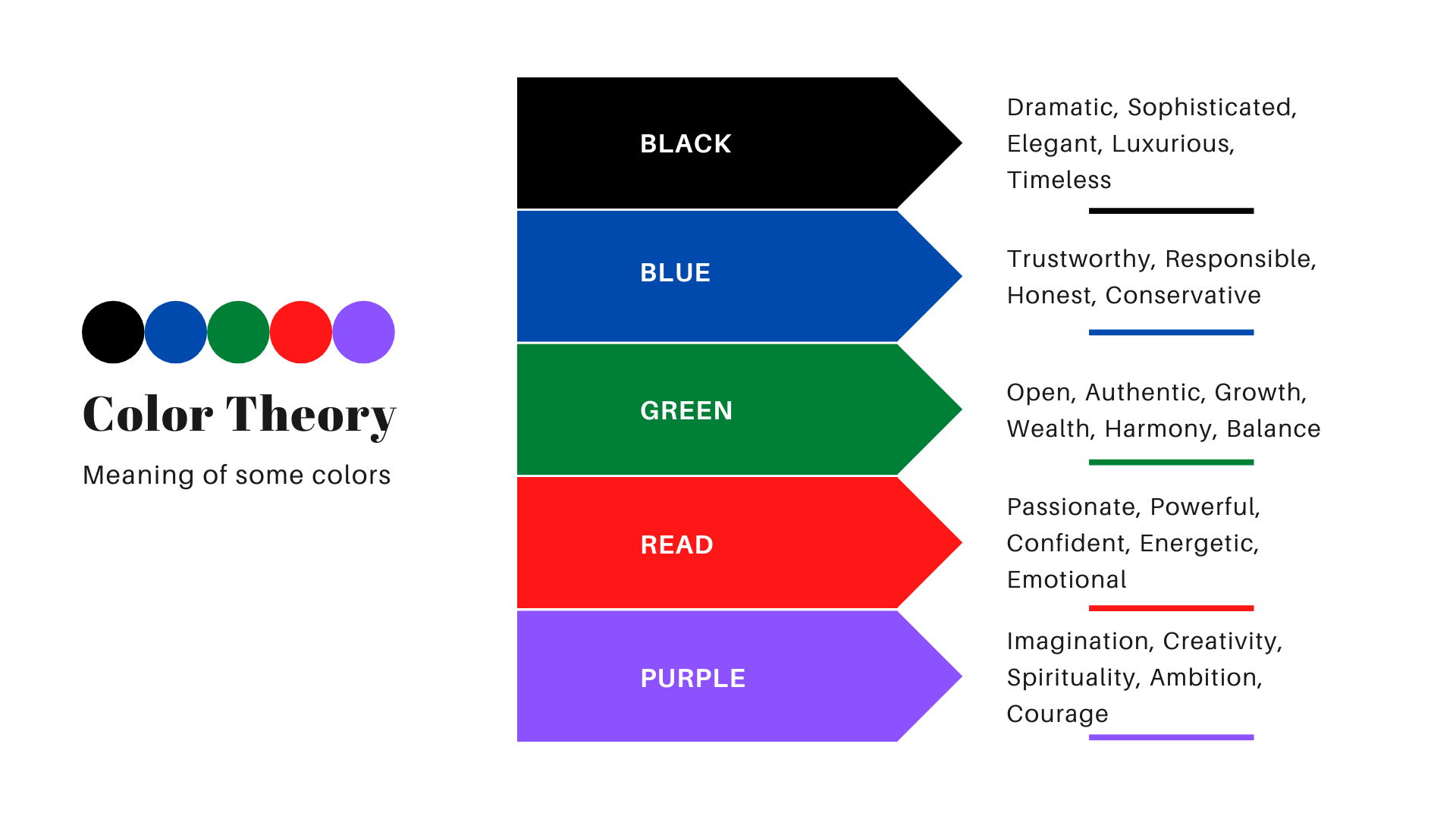
meaning of some common colors
Day 13 | Daily Dose of learning
This project is inspired by the ‘100-day project’, a challenge consisting of committing to doing an activity everyday for 100 days.
I have decided to write about one thing I learn everyday for the next 30 days. This can be a skill, a deep concept to elaborate on, or a mere life lesson that made me become aware of something I consider relevant.
The decision is based on the belief that “we are what we repeatedly do”, as Valentin Perez put it.
Deliberate Practice
Learning a skill, mastering an activity, becoming great at some discipline, all require deep, purposeful, consistent practice over the long run.
That’s deliberate practice. Working a lot on developing specific skills. Which is different from merely working a lot (many hours). Deliberate practice has purpose and intentionality.
As professor Hayes, when studying this very subject, discovered that great artists did not produce any relevant piece until having made art and worked hard for 10 years, this ‘rule’ applies to every discipline one wants to master.
He defined this time period of hard work and little recognition the ‘ten years of silence’.
Day 12 | Daily Dose of learning
This project is inspired by the ‘100-day project’, a challenge consisting of committing to doing an activity everyday for 100 days.
I have decided to write about one thing I learn everyday for the next 30 days. This can be a skill, a deep concept to elaborate on, or a mere life lesson that made me become aware of something I consider relevant.
The decision is based on the belief that “we are what we repeatedly do”, as Valentin Perez put it.
Color Theory
Started to follow a course on color theory on Skillshare today. Color theory is what explains the rationale behind colors and the emotions we associate with them; why we like some colors more than others (although this has to do more with psychological factors); and most importantly how to combine colours in a way that makes sense and is aesthetically pleasing.
Originally invented by Isaac Newton, the color wheel has 3 colors as its foundation: red, blue, yellow (primary colors).

Consequently, when choosing colors for design or whatever project, respecting the color wheel and choosing colors that fit well together is very relevant in order to produce aesthetically-pleasing end-products.
When making color combinations, one can choose among numerous ‘harmonies’: complementary colors (those that are opposite on the color wheel); analogous (colors sitting near each other on the wheel); monochromatic (only one color but different shades) among the main possible palettes used.
Day 11 | Daily Dose of learning
This project is inspired by the ‘100-day project’, a challenge consisting of committing to doing an activity everyday for 100 days.
I have decided to write about one thing I learn everyday for the next 30 days. This can be a skill, a deep concept to elaborate on, or a mere life lesson that made me become aware of something I consider relevant.
The decision is based on the belief that “we are what we repeatedly do”, as Valentin Perez put it.
Content Cards using HTML and CSS
Today I worked on improving the design of responsive content cards using HTML and CSS on codepen.

screenshot of a content card designed.
I started from a template which I found on Codepen and then developed my own version from there. Currently encountering issues with making them responsive, as at certain widths of the page the cards get thinner and a white background pops up below the button.

Also, still not sure about whether to keep images at the top or substitute them with icons, which would make the card a bit more simple-looking and minimal.